How a Texas Farming Company Grew Organic Traffic 100x Without Paid Links
A technical and on-page SEO campaign for a Texas-based farming company, growing organic traffic from 33 to 3,403 monthly visits through a full site restructure - with no link-building campaign and no paid links.
Confidentiality Declaration
Client Identity Withheld Under NDA
This campaign is published with the client's brand name and domain intentionally withheld to honor contractual confidentiality requirements. The industry, markets, strategy, and performance data are shared in full so the work can be evaluated without compromising client confidentiality.
The Early Signal - First 28 Days
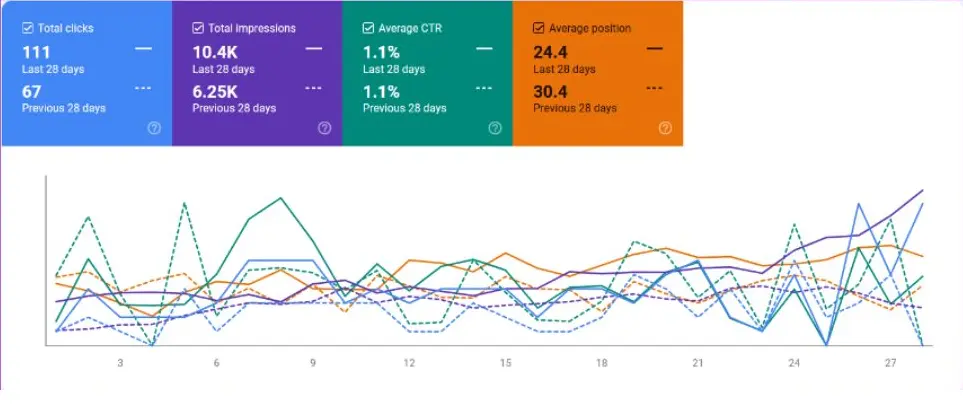
The early signal in Google Search Console: in the first weeks after the restructure, organic clicks rose 65.7% (67 to 111) and impressions 66.4% (6.25K to 10.4K), with average position improving from 30.4 to 24.4.
Early Search Console Trend
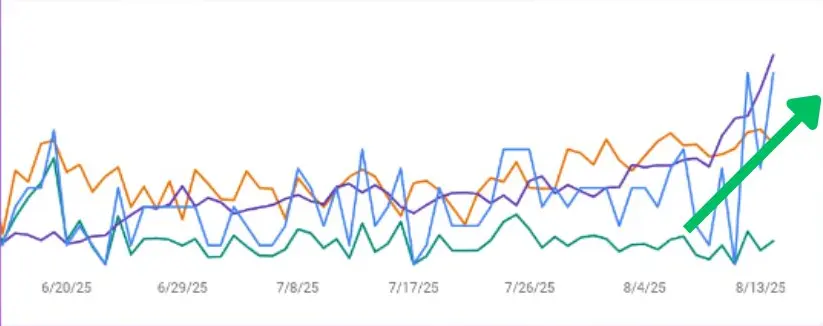
The early Search Console trend showed clicks and impressions climbing steadily rather than spiking once - the signature of a site restructure settling in as Google re-crawls the new URL architecture.
Organic Traffic: 33 to 3,403

Semrush tells the long-term story: estimated organic traffic climbed from just 33 monthly visits in late August 2025 to 3,403 by January 2026 - a near 100-fold increase, with paid and branded traffic at zero the entire time.
The Full Picture by January 2026
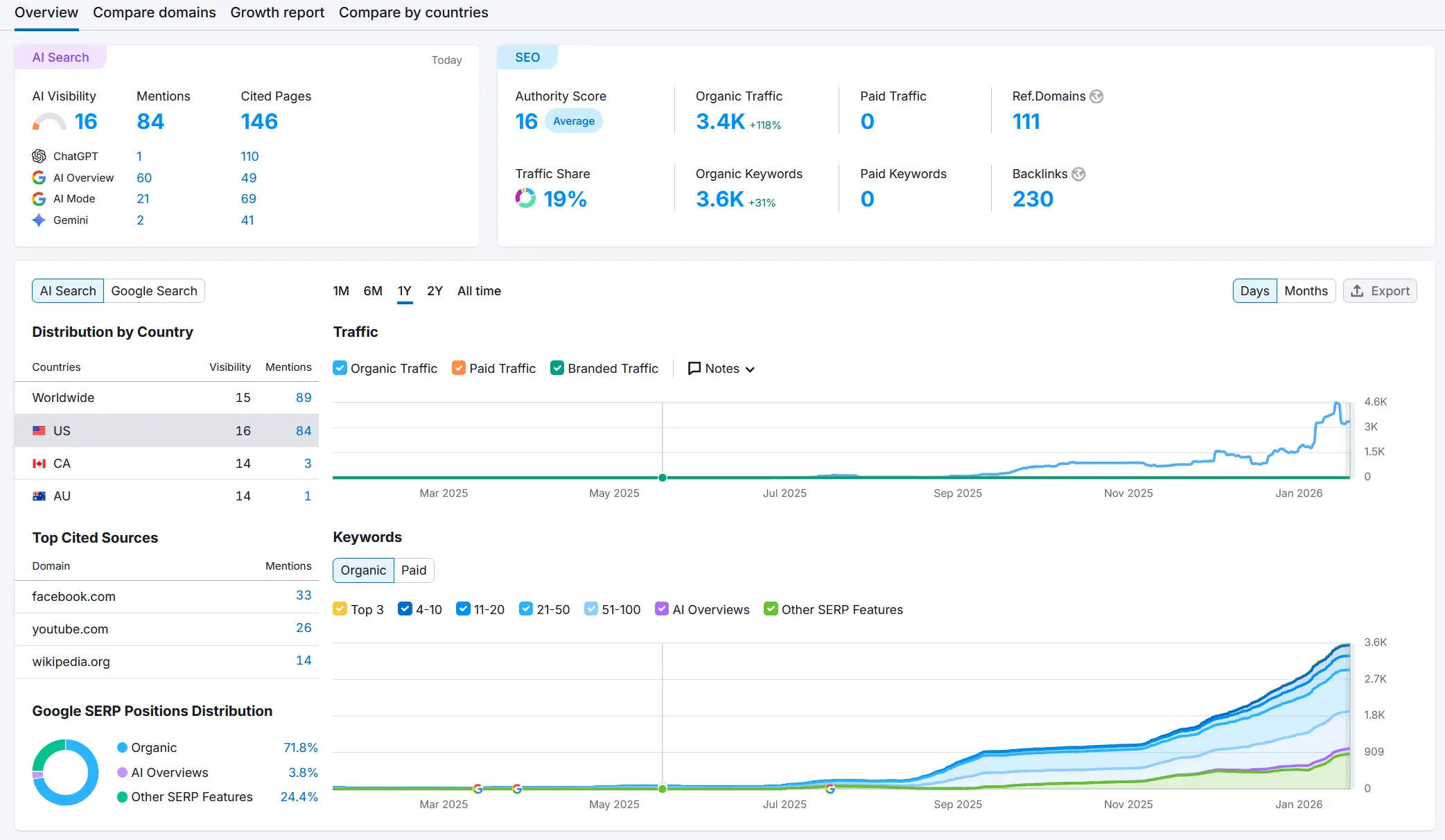
The full Semrush snapshot by January 2026: roughly 3.4K monthly organic visits (+118% over the trailing period), 3.6K organic keywords (+31%), and a 19% traffic share - plus 230 backlinks from 111 referring domains earned with zero outreach or paid links. The links followed the work; they were never the strategy.
01
Challenge
The client is a Texas-based farming company competing against larger, better-funded brands in its space. They were already earning real but modest organic interest - a few clicks a day - and had a genuine ambition to grow, but not the budget to go head-to-head with bigger competitors on link building. In a niche where everyone assumes you have to buy your way to the top with links and outreach, that can feel like a dead end.
The deeper problem was structural. This was a fully custom-coded website - built on Next.js, React, and AWS, with no CMS to fall back on - and its architecture was working against it: a flat, unclear structure that gave Google little signal about how the site's pages related to one another or which ones deserved to rank. The business was already getting some clicks and income, but the foundation itself was capping its growth. The real question was never "how do we get more links" - it was "how do we unlock what this site should already be ranking for."
02
Solution
We made a deliberate decision: focus one hundred percent on on-page, technical, and site-structure optimisation, with zero link building and zero outreach. The principle behind it is one most people have heard but few act on - Google ranks pages, not websites. If every individual page could be made clearer, faster, and better structured, the rankings would follow without spending a cent on links.
I'll be honest about the risk, because it was real. A sitewide restructure means new URLs and redirects across the entire site, and on a fully custom-coded Next.js and React build deployed on AWS, there is no CMS safety net to catch a mistake. Executed well, traffic climbs. Executed badly, the business loses every bit of progress it has made. That is not a decision an SEO should make alone, so I laid out both outcomes honestly for the leadership team. After that conversation we agreed together: take the calculated risk and grow, or stay exactly where we are. We chose to grow.
From there the work was methodical. I rebuilt the site's architecture around a clear, logical hierarchy, rewrote the URL structure to match, and mapped a complete set of redirects so no ranking equity or indexed page was lost in the move. Every page was then optimised on-page - titles, meta data, heading structure, internal linking, and content - so that each one earned its visibility on its own merits.
None of this works without precise execution, so credit where it is due: to the senior management who backed a bold strategy, and to the developer who implemented the restructure and redirects exactly as specified. A technical SEO plan is only ever as good as the build behind it.
03
Result
The first signal came quickly. Within the opening weeks after the restructure went live, Google Search Console already showed organic clicks up 65.7% (67 to 111) and impressions up 66.4% (6.25K to 10.4K), with average position improving from 30.4 to 24.4. Encouraging movement - but on a small base, and exactly the kind of early lift that tells you the foundation is finally working.
What happened over the following months is the real story. As Google fully re-crawled the new architecture and the restructured pages compounded, Semrush-estimated organic traffic climbed from roughly 33 monthly visits in late August 2025 to around 3,403 by January 2026 - a near 100-fold increase. Organic keywords grew to 3.6K and the site reached a 19% traffic share across its US, Canadian and Australian search markets.
And every bit of it was earned the hard way: through site structure, technical health, and on-page relevance, with no link-building campaign, no outreach, and not a single paid link. The site even went on to attract 230 backlinks from 111 referring domains entirely on its own - proof that when the work is good enough, the links follow rather than lead.
The lesson is the one we set out to prove: you do not need to out-spend bigger competitors on links to beat them. Fix the foundation, earn relevance page by page, and the traffic - and even the links - will come. Sometimes the biggest gains come from being willing to change the foundation, not just add to it.
About the Author
Next Step
Ready to see results like these?
Let's talk about what a focused SEO strategy could deliver for your business. No agency layers, no junior staff - just direct specialist work.